
Blueprint
  • WHO WE ARE
    • Our Approach
    • Our History
    • Commitment to Equity
    • Board of Directors
    • Team
    • Contact Us
  • WHAT WE DO
    • Our Services
    • Our Projects
    • Our Impact
    • Our Blog
    • Our Financing Options
  • WORK WITH US
    • School Partners
    • Philanthropic Partners
    • Internship Program
    • Careers
  • WHERE WE ARE
    • California
    • Colorado
    • Texas
    • Washington
Blueprint
  • Skip to primary navigation
  • Skip to main content
Blueprint

Blueprint

Expanding educational opportunities for students in under-resourced communities

  • WHO WE ARE
    • Our Approach
    • Our History
    • Commitment to Equity
    • Board of Directors
    • Team
    • Contact Us
  • WHAT WE DO
    • Our Services
    • Our Projects
    • Our Impact
    • Our Blog
    • Our Financing Options
  • WORK WITH US
    • School Partners
    • Philanthropic Partners
    • Internship Program
    • Careers
  • WHERE WE ARE
    • California
    • Colorado
    • Texas
    • Washington

finance

Colorado’s New Bond Legislation: What Charter Schools Need to Know About Facility Funding

October 14, 2026 by Blueprint

New legislation creates opportunities for Colorado charter schools to participate in district bond planning. Blueprint Colorado shares practical steps schools can take to prepare.

Access to adequate, high-quality facilities remains one of the greatest challenges facing public charter schools. In Colorado, new legislation offers an important opportunity for charter schools to have their facility needs considered as part of school district bond planning.

On August 28, Blueprint Colorado Executive Director Joy Griffin joined Prateek Dutta, Vice President of Policy at CLCS Action, at the Colorado League of Charter Schools’ Annual Finance Seminar to discuss Senate Bill 26-145 and what it means for charter school leaders.

Their session, Colorado’s New Bond Bill: New Opportunities for Charter School Facilities, explored the legislation and outlined practical steps schools can take to position themselves for future capital funding opportunities.

Understanding Senate Bill 26-145

Senate Bill 26-145 establishes new requirements for school districts considering ballot measures to fund capital construction. Under the legislation, districts must solicit proposals from their charter schools regarding facility needs, provide equitable consideration, and notify schools whether their projects will be included in a proposed ballot measure.

While the legislation does not guarantee funding, it creates a more structured and transparent process for charter schools to participate in district capital planning.

For charter school leaders, the message is clear: early engagement and thoughtful facility planning are essential.

Four Steps Charter Schools Can Take Now

During the seminar, Joy and Prateek highlighted four important actions schools can take to prepare for future bond opportunities.

  1. Get Involved Early

Building productive relationships with district leadership is an important first step.

Charter schools should understand their district’s long-range facilities planning process, participate in relevant planning committees, and maintain regular communication with district board members, superintendents, and other leaders.

Schools can also strengthen these relationships by sharing their educational achievements, unique programs, and contributions to the broader community.

Community partners can play an important role as well, helping schools communicate their facility needs and build support for proposed projects.

  1. Be Prepared with a Long-Term Facilities Plan

Successful facility projects begin well before funding becomes available.

Schools should develop and regularly update a comprehensive facilities plan that identifies current conditions, future needs, and capital priorities.

This includes assessing major building systems, documenting maintenance needs, identifying health and safety improvements, and forecasting capital replacements over a five- to ten-year period.

Planning ahead is particularly important given the time required to deliver school facilities. New school construction or development typically takes 18 to 36 months, while renovation projects can take eight to twelve months or longer, depending on scope and permitting.

A well-developed facilities plan helps school leaders make informed decisions and respond when funding opportunities arise.

  1. Understand the Bond Planning Timeline

Timing is critical.

Under SB 26-145, districts considering a capital construction ballot question must solicit charter school proposals as early as practicable and no later than 120 days before board approval of the ballot measure.

The legislation also establishes opportunities for charter schools to present their proposals and receive written notification about whether their projects will be included.

Schools should familiarize themselves with these requirements, understand their district’s planning calendar, and prepare complete proposals that clearly describe project needs, estimated costs, timelines, and funding strategies.

Maintaining documentation and communicating in writing throughout the process can also help ensure that proposals receive appropriate consideration.

  1. Advocate for Your School’s Facility Needs

Charter school leaders are often their schools’ strongest advocates.

Engaging with district leadership, participating in public meetings, and communicating facility priorities to community partners can help ensure that charter school needs are part of broader capital planning conversations.

Schools should also review their charter contracts to understand how existing provisions address district bond participation and consult legal counsel about potential updates under the new legislation.

Effective advocacy begins with preparation, collaboration, and a clear understanding of how facility investments support students and educators.

Planning Today for Tomorrow’s Opportunities

At Blueprint, we know that creating safe, inspiring learning environments requires more than securing a building. It takes strategic planning, financial expertise, strong partnerships, and a long-term commitment to a school’s success.

Through our work with charter schools across Colorado, we help school leaders navigate the complexities of facility development, from early planning and feasibility through financing, construction, and occupancy.

Colorado’s new bond legislation offers another opportunity for schools to think strategically about their long-term facility needs and engage with district partners.

We appreciate the Colorado League of Charter Schools and CLCS Action for bringing school leaders together to explore these important developments. We look forward to continuing to support Colorado charter schools as they plan for the facilities their students and communities deserve.

To learn more about how Blueprint Colorado supports charter school facility planning and development, visit blueprintfutures.org/colorado.
Filed Under: Blog, Colorado Tagged With: finance, public finance

The Importance of Investments

March 18, 2026 by Blueprint

Who did you meet with today?

We met with Crystal Langdon.

Where do they work? What does the company do?

Crystal Langdon is the Director of Investments at Blueprint, holding many responsibilities in this position. Crystal evaluates if school construction projects are affordable and financially possible. Her role also includes managing a team that finds funding for building schools. The role also oversees investments in school construction projects and monitors them over time to make sure borrowers or tenants follow the agreement, and the project stays financially stable.

What did you learn today? What were some highlights?

Today I learned about different loan types and how interest rates can affect individuals’ decisions on where to get loans from. We learned about how interest rates and loan terms affect the overall cost of a loan, and how to find the best fit that will allow the development of a project.

What insights did you gain into the field of real estate development?

We got insight into the finance and investment side of real estate development. We learned about how important this role is for Blueprint and how this role is important for all organizations since they have to secure funding in order for development projects to even begin.

What did you find the most interesting about the field in the field after today?

After learning about this field, what intrigued me the most was learning about how interesting and important this field is in real estate development, and it has led me to have an interest in pursuing this field.

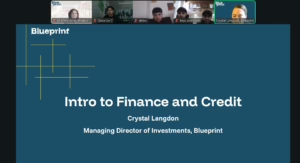
A presentation slide titled Intro to Finance and Credit by Crystal Langdon, Managing Director of Investments at Blueprint, highlighting the importance of investments, with video call participants shown in a row at the top of the screen.
Interns learning about finance and credit from Crystal Langdon.
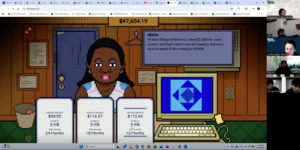
A pixel art woman sits at a desk with a vintage computer. Text above says she needs $2,000 for a washer and dryer, highlighting the importance of investments as various bills are shown below. The total owed is $47,654.19.
The interns playing Shady Sham to learn about credit and loans.
A screenshot of a virtual meeting with seven participants in individual video boxes, some with blueprint virtual backgrounds, others in dimly lit rooms, all engaged in a discussion on the importance of investments and their benefits.
The interns learning from Crystal.

Filed Under: Blog Tagged With: finance, internships

An Introduction to Project Finance Coordination

February 27, 2026 by Blueprint

Who did you meet with today?

Today we met with Scott Thomas, who works in financing. Thomas works as a project finance coordinator.

Where do they work? What does the company do?

Thomas works in Blueprint. Blueprint is a development firm that helps schools with most aspects of their projects.

What did you learn today? What were some highlights?

Today I learned what a contingency is, which is a safety valve just incase anything unexpected comes up in the project. A highlight was when we got to see the spreadsheet of the budget; it was nice getting to see a real project’s budget and the process. Another highlight I would like to mention was when my peers and I asked Thomas questions; it was really insightful and even let us get a preview into who we would meet next.

What are you looking forward to most during the internship?

During the internship I am now looking most forward to meeting with Blueprint’s lawyer and the other lawyer we will get to meet with.

What insights did you gain into the field of real estate development?

In the field of real estate development, I gained insights such as what struggles the project finance coordinator faces while communicating with the school. I also received insight into how the finance project coordinator tracks the budget and the different factors that allow the school to stay within their budget affordably.

What did you find the most interesting about the field after today?

After today, what I find most interesting about the field is how the project finance coordinator ultimately works as the middleman between the loaners and the school and how they play a key role in allowing the school to meet their financial goal to finish their project.

Photos: Jose Burgos Arroyo, Spring Intern

Scott Thomas presenting to the interns on project finance
Scott Thomas sharing his career pathway
Scott Thomas sharing the flow of money through a project

Filed Under: Blog Tagged With: finance, internships

Copyright © 2026 · PCSD 2022 on Genesis Framework · WordPress · Log in

Blueprint

Blueprint's mission is to dismantle systemic inequality in education by expanding educational opportunities for students in under-resourced communities.

Contact Us

info@blueprintfutures.org
(213) 542-4700 (office)
(213) 542-4701 (fax)

Quick Links

Who We Are
Work With Us
What We Do

Our Projects
Contact Us

Newsletter

This field is for validation purposes and should be left unchanged.

Regions

Southern California (Main Office)
915 Wilshire Blvd, Ste 700
Los Angeles, CA 90017

Northern California
66 Franklin St, Ste 300
Oakland, CA 94607

Colorado
4600 South Syracuse St, Ste 900
Denver, CO 80237

Texas
2700 Post Oak Blvd, Ste 2100
Houston, TX 77056

Washington
1201 2nd Ave, Ste 900
Seattle, WA 98101

© Copyright 2026 Blueprint. All Rights Reserved.

Privacy Policy

Blueprint
  • WHO WE ARE
    • Our Approach
    • Our History
    • Commitment to Equity
    • Board of Directors
    • Team
    • Contact Us
  • WHAT WE DO
    • Our Services
    • Our Projects
    • Our Impact
    • Our Blog
    • Our Financing Options
  • WORK WITH US
    • School Partners
    • Philanthropic Partners
    • Internship Program
    • Careers
  • WHERE WE ARE
    • California
    • Colorado
    • Texas
    • Washington
  • This field is for validation purposes and should be left unchanged.